Mobile:
+86 177 2975 3706
E-mail:
info@pursysmachine.com
News · Sep. 14, 2026 · Spice Grinding
Spice grinding is more than simply reducing whole spices into smaller particles.
For industrial spice processing, the grinding system must consider raw material condition, moisture, feed size, target particle size, heat generation, dust control, screening and production capacity.
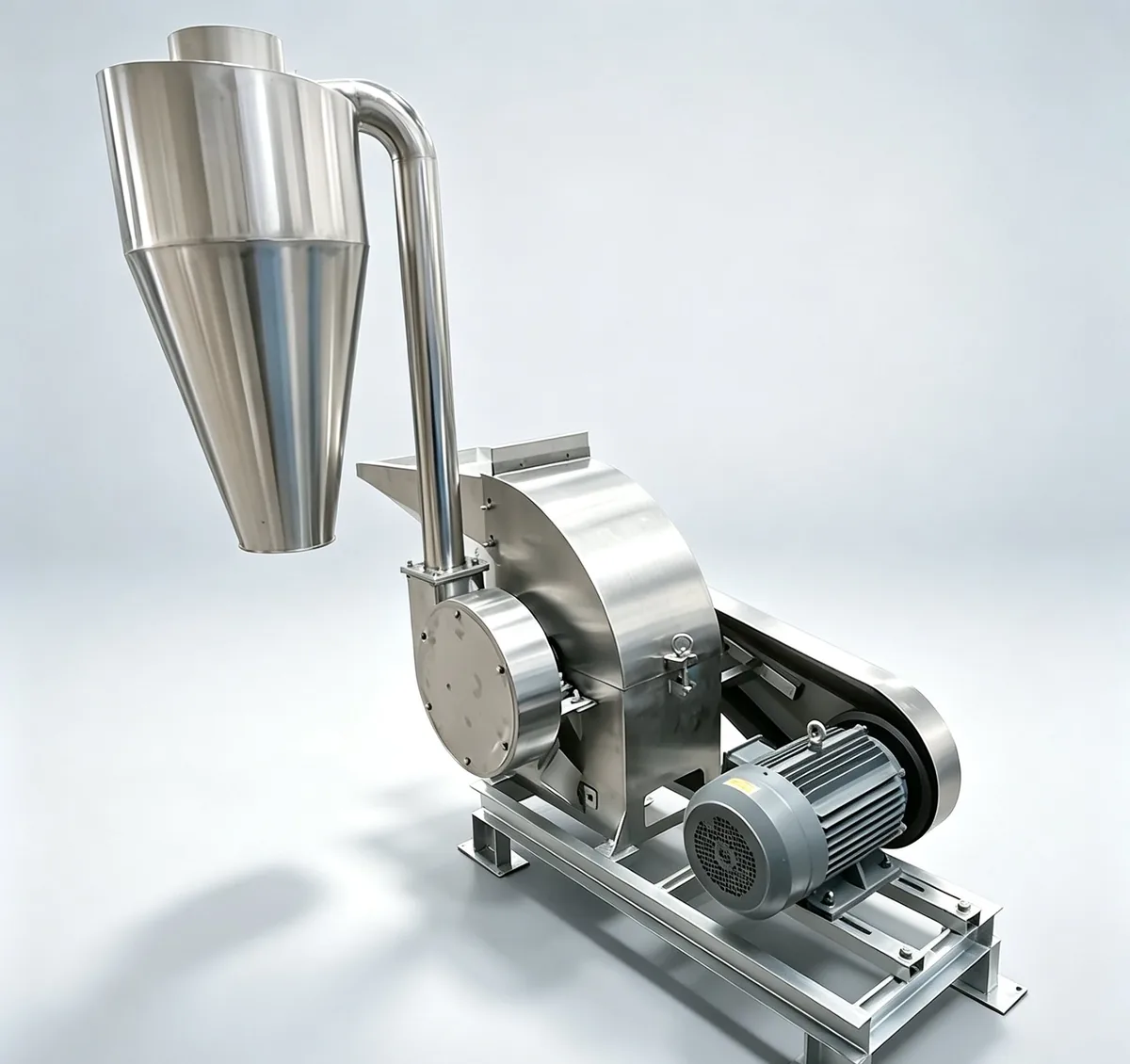
A properly selected hammer mill for spice grinding can be an important part of an industrial spice powder processing system.
This guide explains how hammer mills are used for spices, what affects grinding performance, how to select the right equipment, and when a complete spice grinding line may be more suitable than a standalone machine.
A hammer mill for spice grinding is an impact-type grinding machine that uses rapidly rotating hammers to break spices into smaller particles.
Depending on the spice and the required final powder size, the grinding process may involve:
Whole Spices → Cleaning / Sorting → Pre-Crushing → Hammer Mill Grinding → Fine Grinding if Required → Vibrating Screening → Dust Collection → Packaging
The hammer mill can therefore function as either the primary grinding machine or one stage within a larger spice powder processing system.
Spices have different structures and grinding characteristics.
For example:
A hammer mill works primarily through impact and particle breakage.
This makes the technology suitable for many dry spice grinding applications.
However, the best grinding configuration depends on the actual raw material and final powder requirements.
The objective is not simply to choose the machine with the highest nominal power.
The objective is to achieve:
Consistent particle size + stable throughput + controlled temperature + manageable dust + reliable operation
The basic grinding principle is straightforward.
Cleaned spices are introduced into the grinding chamber through the feeding system.
The feed rate should remain reasonably stable.
An uncontrolled feed rate can affect grinding consistency and machine performance.
Inside the grinding chamber, rotating hammers repeatedly impact the spice material.
The particles are progressively reduced in size.
A screen controls which particles can leave the grinding chamber.
Particles that are still too large remain in the grinding zone until they reach the required size.
The ground spice powder exits the mill and can then move to screening, collection or packaging.
A simplified process is:
Spice Material → Feeding → Hammer Mill → Impact Grinding → Screen Control → Spice Powder → Screening / Collection → Packaging
A hammer mill can be considered for many dry spice applications.
Typical examples include:
| Spice | Typical Processing Consideration |
|---|---|
| Chili | Fibrous material and heat management |
| Turmeric | Hard material and particle-size control |
| Ginger | Fiber and moisture can affect grinding |
| Coriander | Seed structure and desired powder size |
| Cumin | Feed condition and target fineness |
| Pepper | Hardness, oil content and particle size |
| Fennel | Seed structure and powder consistency |
| Other dry spices | Application-specific testing |
The important point is that not every spice should automatically use the same grinding configuration.
Raw material characteristics should be evaluated before selecting the final system.
Chili is one of the most common industrial spice grinding applications.
However, chili grinding presents several challenges.
Chili skins and other fibrous components can influence grinding performance.
Excessive heat can affect the quality of some spice products.
Fine chili powder can generate substantial airborne dust.
Different customers may require different powder fineness levels.
A typical industrial chili grinding process may therefore look like:
Dried Chili → Cleaning → Stem / Foreign Material Removal → Pre-Crushing → Hammer Mill → Fine Grinding → Vibrating Screen → Dust Collection → Finished Chili Powder
For more detailed chili processing information, see:
Related: How To Make Chili Powder
For a complete industrial line:
Related: Chili Powder Production Line
Turmeric presents a different grinding challenge.
Dried turmeric can be relatively hard, and the material may require size reduction before fine grinding.
A possible process is:
Dried Turmeric → Cleaning → Drying / Moisture Control → Primary Crushing → Hammer Mill → Fine Grinding → Screening → Dust Collection → Packaging
For turmeric processing, particle size, feed condition and heat management should all be considered.
More detailed information is available in:
Related: Turmeric Powder Processing
And for complete production-line planning:
Related: Turmeric Powder Production Line
One of the most important components in many hammer mills is the screen.
The screen helps control the size of particles leaving the grinding chamber.
A general relationship is:
Smaller screen openings can help produce finer particles, but may also affect throughput and energy consumption.
However, screen size should not be treated as the only factor controlling final powder fineness.
Other factors include:
Therefore, selecting a screen based only on the desired mesh number can lead to poor results.
There is no single answer for every spice.
The achievable particle size depends on:
For example, a customer producing a relatively coarse spice powder may require only one grinding stage.
Another customer producing a finer commercial powder may require:
Hammer Mill → Fine Grinder → Vibrating Screen
This is why the final particle-size requirement should be established before designing the equipment system.
Hammer mills and pin mills can both be used in powder processing, but they have different characteristics.
| Factor | Hammer Mill | Pin Mill |
|---|---|---|
| Main mechanism | Impact | Impact / shearing |
| Typical role | Primary or general grinding | Fine grinding |
| Suitable materials | Many dry materials | Many dry materials |
| Coarser reduction | Strong application | Less typical |
| Fine powder | Possible depending on configuration | Often advantageous |
| System role | Primary grinding / size reduction | Fine grinding |
| Selection | Material dependent | Material dependent |
For some spice applications, the two machines may even be used at different stages.
For example:
Raw Spice → Primary Crushing → Hammer Mill → Pin Mill → Screening → Final Powder
The correct solution depends on the target product rather than simply choosing one machine type.
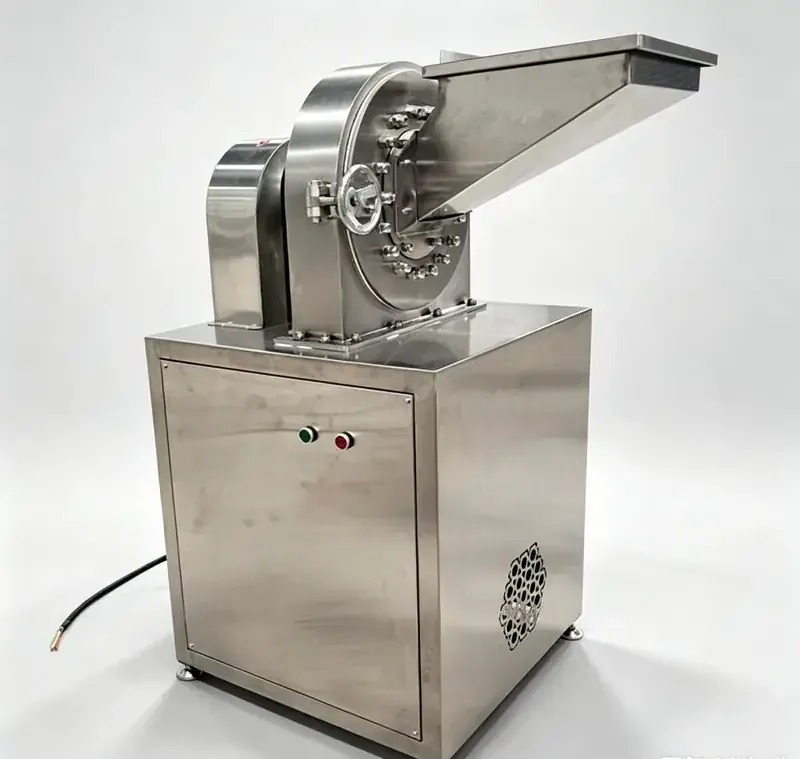
Related: Hammer Mill Vs Pin Mill
Large pieces of raw material may not be ideal for direct feeding into a fine grinding machine.
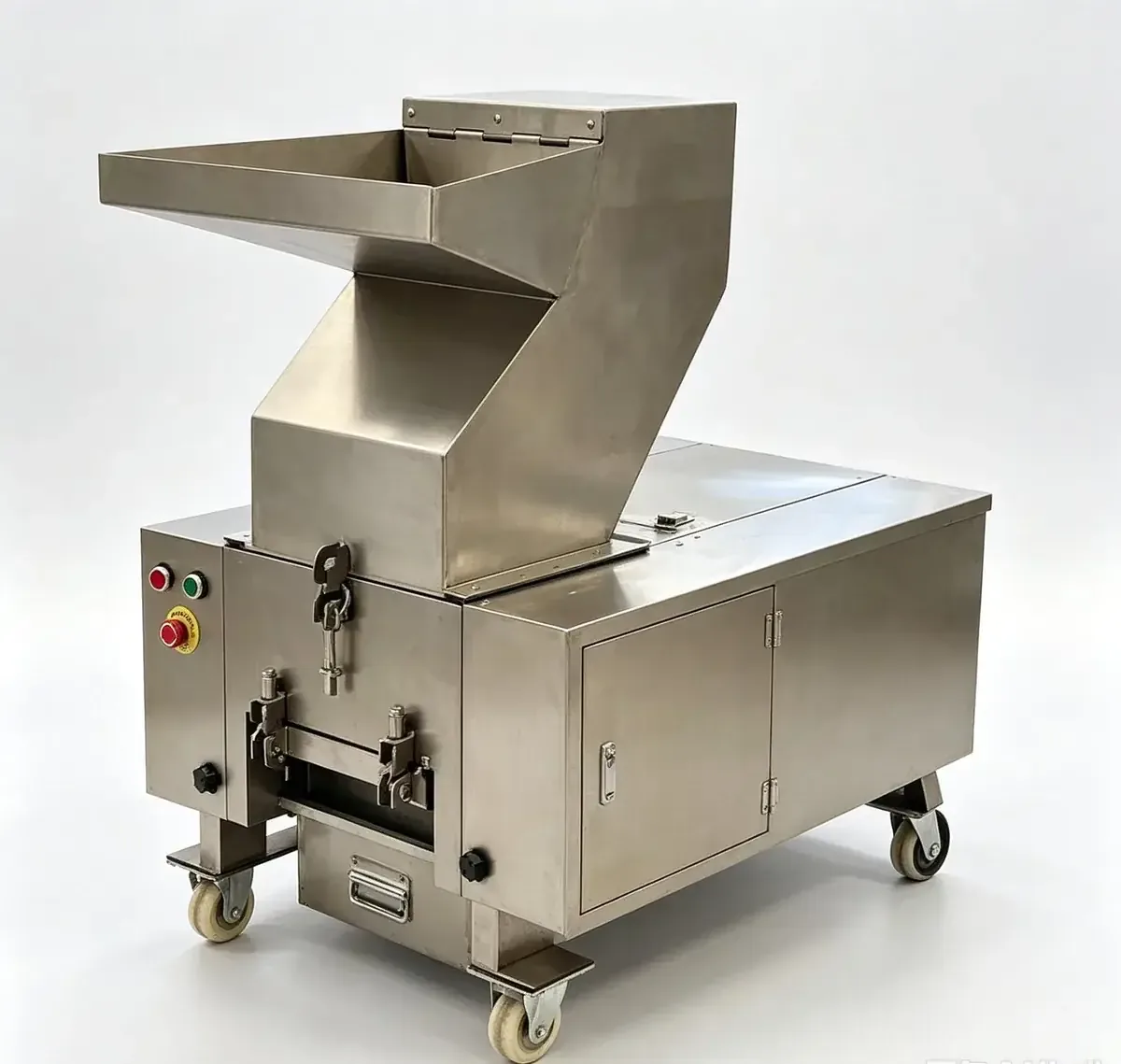
A primary crusher can reduce the incoming material size before the hammer mill.
A possible configuration is:
Raw Spice → Primary Crusher → Hammer Mill → Fine Grinding → Screen
This can help create a more controlled feed condition for subsequent grinding stages.
For equipment information:
Related: Primary Crusher
Temperature is an important consideration in spice processing.
Grinding converts mechanical energy into heat.
If a process generates excessive heat, the final product may not meet the desired quality requirements.
The actual temperature behavior depends on:
Therefore, industrial spice grinding should not be designed around throughput alone.
A good system balances:
Capacity + particle size + temperature + product quality
Fine spice powder can generate significant dust during:
A dust collection system can therefore be an important part of an industrial spice processing line.
A simplified system may look like:
Hammer Mill → Air / Powder Flow → Dust Collection → Filtered Air
Dust collection can help improve:
The dust collection system should be designed together with the grinding equipment rather than treated as an afterthought.
Grinding does not always produce particles with exactly the same size.
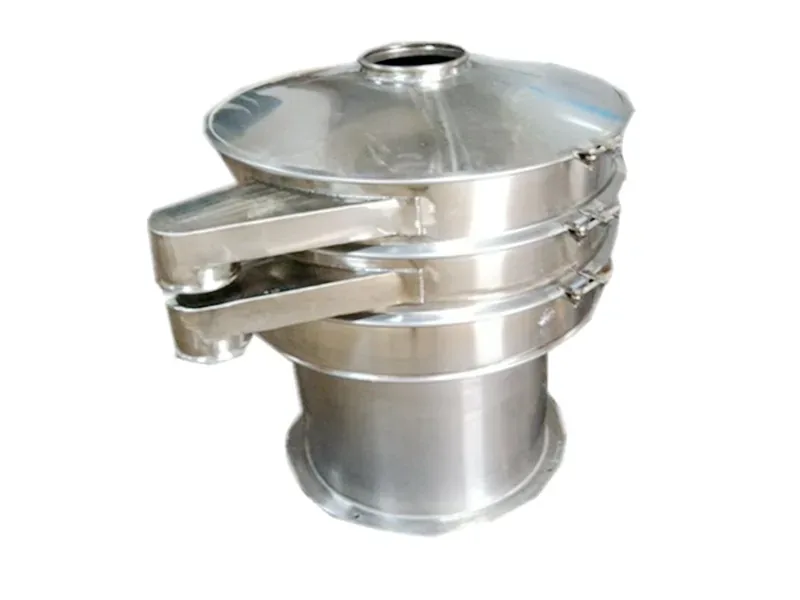
A vibrating screen can separate particles according to the selected screening specification.
Typical process:
Ground Spice Powder → Vibrating Screen → Fine Powder Oversize → Re-Grinding
This creates a more controlled final product.
For an industrial processing system:
Related: Round Vibrating Screen
A standalone machine may be suitable for some applications.
For example:
Feeding → Hammer Mill → Collection
But larger or more automated projects may require multiple pieces of equipment.
A more complete system could include:
Raw Material → Cleaning → Primary Crushing → Hammer Mill → Fine Grinding → Vibrating Screen → Dust Collector → Conveying → Packing
The advantage of a complete line is that the equipment can be designed as a coordinated process rather than a collection of independent machines.
Capacity should not be selected from the machine name alone.
Actual production depends on the application.
Important variables include:
For example, the same hammer mill may process different materials at different rates.
Therefore, a realistic quotation should be based on the customer's actual process requirements.
When requesting a spice grinding solution, provide:
For food and spice applications, equipment construction is an important consideration.
Stainless steel is commonly considered for processing equipment where cleanliness, corrosion resistance and easy cleaning are important.
However, the exact material specification should be selected according to:
PURSYS can design equipment configurations according to the specific application and project requirements.
Before purchasing a spice hammer mill, evaluate these factors.
Chili, turmeric, ginger and seeds can have different grinding behavior.
Large material may require pre-crushing.
The answer determines the grinding and screening configuration.
Capacity should be evaluated together with particle size and raw material condition.
If product quality is sensitive to heat, the system should be designed accordingly.
For industrial spice powder production, dust management is often an important consideration.
If a controlled particle-size distribution is needed, a vibrating screen may be added.
For larger projects, integrated equipment may be more practical than a standalone grinder.
Higher power does not automatically mean better grinding performance.
The material and target particle size are equally important.
Moisture can significantly affect grinding behavior.
A high throughput number is meaningless if the machine cannot achieve the required final powder quality.
Dust management should be considered during system design.
The final particle size should be established first.
A complete production system may also require:
Consider a hypothetical customer producing dried chili powder.
The customer requires:
A possible process could be:
Dried Chili → Feeding → Primary Crusher → Hammer Mill → Fine Grinding → Vibrating Screen → Dust Collection → Conveying → Automatic Packing
The exact equipment configuration would depend on the customer's material and production requirements.
This example is illustrative only; actual capacity and equipment selection must be determined from application data.
Before requesting a quotation, prepare the following information:
| Requirement | Customer Information |
|---|---|
| Raw material | Chili / turmeric / ginger / other |
| Initial size | ___ |
| Moisture | ___ |
| Final particle size | ___ |
| Required capacity | ___ |
| Operating hours | ___ |
| Grinding stages | ___ |
| Screening | Yes / No |
| Dust collection | Yes / No |
| Feeding system | Manual / Automatic |
| Conveying | Required / Not required |
| Packaging | Manual / Automatic |
This information allows an equipment supplier to recommend a more suitable grinding configuration.
For a broader understanding of industrial grinding:
Industrial Grinding Machine Guide /industrial-grinding-machine.html
For hammer mill fundamentals:
Hammer Mill Machine Guide /hammer-mill-machine.html
For spice processing:
Spice Powder Processing /spice-powder-processing.html
For chili:
How to Make Chili Powder /how-to-make-chili-powder.html
Chili Powder Production Line /chili-powder-production-line.html
For turmeric:
Turmeric Powder Processing /turmeric-powder-processing.html
Turmeric Powder Production Line /turmeric-powder-production-line.html
For machine selection:
Hammer Mill vs Pin Mill /hammer-mill-vs-pin-mill.html
PURSYS focuses on industrial powder processing equipment and complete process solutions.
Instead of selecting a grinder independently, the system can be evaluated as a complete process:
Raw Material → Crushing → Grinding → Screening → Dust Collection → Conveying → Packing
This approach helps match the equipment configuration to the actual production requirements.
For a spice grinding project, the most useful information to provide is:
Material + moisture + feed size + target particle size + required capacity
With these parameters, the grinding process can be evaluated and the appropriate equipment configuration can be proposed.
Choosing a hammer mill for spice grinding should begin with the material and final product requirements rather than the machine name alone.
Chili, turmeric, ginger and other spices can have significantly different grinding characteristics. Moisture, feed size, target particle size, capacity, heat generation and dust control all influence the final system design.
For simple applications, a standalone hammer mill may be sufficient.
For larger industrial projects, a complete system combining crushing, hammer milling, fine grinding, screening, dust collection, conveying and packaging may provide a more practical solution.
If you are planning an industrial spice powder project, send PURSYS your raw material, moisture, required particle size and target capacity. The grinding process can then be evaluated based on your actual application.
Tell us what spice you process, your required powder fineness and your target capacity.
Need a hammer mill for spice grinding? Tell PURSYS your spice type + required powder fineness + target capacity. Explore our spice powder processing guide, industrial hammer mill, pin mill, vibrating screen and full range of PURSYS powder processing equipment, or get a quote.
Copyright © Zhengzhou Pursys Machinery Co., Ltd. All Rights Reserved. | XML Sitemap | Site Map
Zhengzhou Pursys Machinery Co., Ltd.
+86 177 2975 3706
+8617729753706
No.21 South Huagong Road, Zhangcun, Gaocun Township, Xingyang City, Zhengzhou City, Henan Province, P.R.China