Mobile:
+86 177 2975 3706
E-mail:
info@pursysmachine.com
News · Sep. 7, 2026 · Grinding Equipment
Choosing the right industrial grinding machine is critical when a powder processing line needs consistent particle size, stable capacity and reliable continuous operation.
Industrial grinding is used to process spices, herbs, grains, chemicals, animal feed and many other dry materials into smaller particles or powders. However, there is no single grinding machine suitable for every material.
The correct equipment depends on the raw material, feed size, moisture content, required particle size, production capacity, temperature sensitivity and overall process design.
This guide explains how industrial grinding machines work, the main machine types, how hammer mills compare with other grinders, and how to select grinding equipment for an industrial powder processing system.
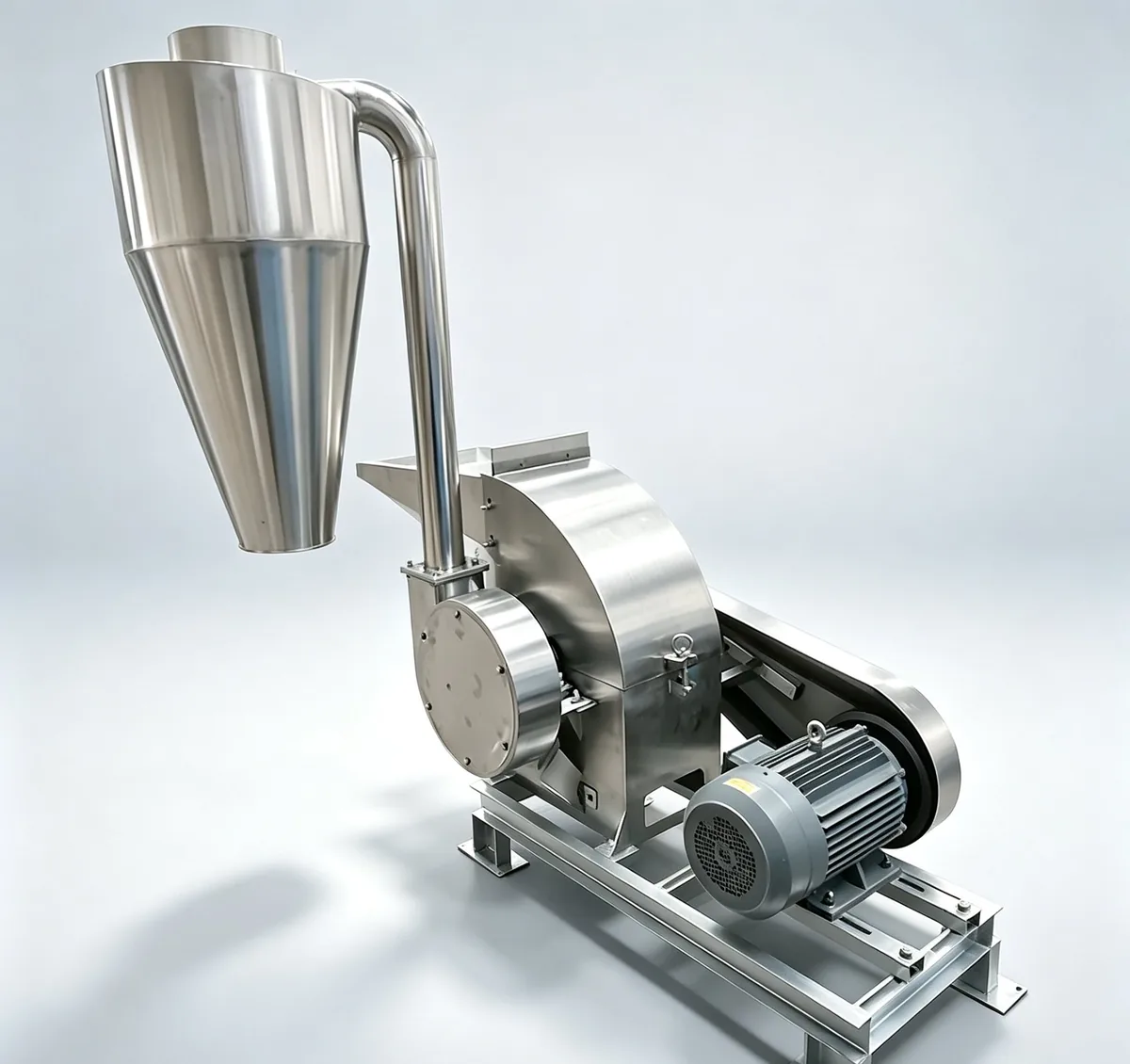
An industrial grinding machine is mechanical processing equipment designed to reduce the size of solid materials into smaller particles or powder.
Unlike small household or laboratory grinders, industrial grinding equipment is designed for:
A typical industrial grinding system can be represented as:
Raw Material ↓
Cleaning / Preparation ↓
Feeding ↓
Primary Crushing ↓
Industrial Grinding Machine ↓
Screening ↓
Dust Collection ↓
Finished Powder ↓
Packaging
The actual process may contain fewer or additional stages depending on the material and required product specification. For example, a relatively brittle material may require only one grinding stage, while a harder or larger raw material may require primary crushing followed by fine grinding.
Industrial grinding machines reduce material size through mechanical forces. Depending on the machine design, these forces can include:
The basic process is:
Material enters ↓
Controlled feeding ↓
Grinding chamber ↓
Mechanical size reduction ↓
Particle classification ↓
Finished powder discharge
The grinding mechanism varies according to machine type. For example, a hammer mill primarily uses high-speed impact between rotating hammers and the material. A pin mill uses impact and shearing between rotating and stationary pins.
Therefore, machine selection should begin with the material and final particle-size requirement rather than simply choosing a machine based on its name.
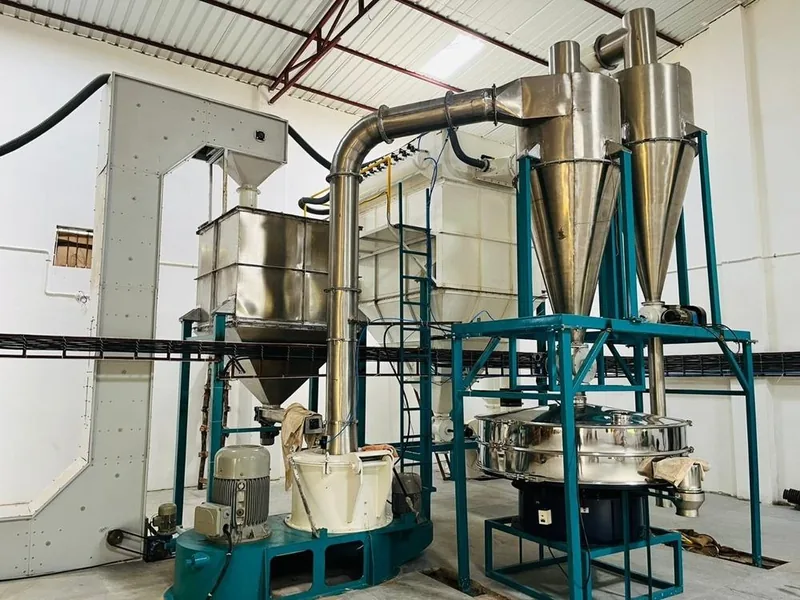
Different industrial grinding machines are designed for different processing requirements. Common categories include:
| Machine Type | Typical Grinding Principle | Common Applications |
|---|---|---|
| Hammer Mill | Impact | Spices, herbs, grains, feed |
| Pin Mill | Impact + shearing | Fine powders, spices, food materials |
| Fine Grinding Machine | Fine size reduction | Fine powder applications |
| Pulverizer | Various mechanical principles | General powder processing |
| Crusher | Compression / impact | Primary size reduction |
Two of the most important machines for dry powder processing are the hammer mill and pin mill.
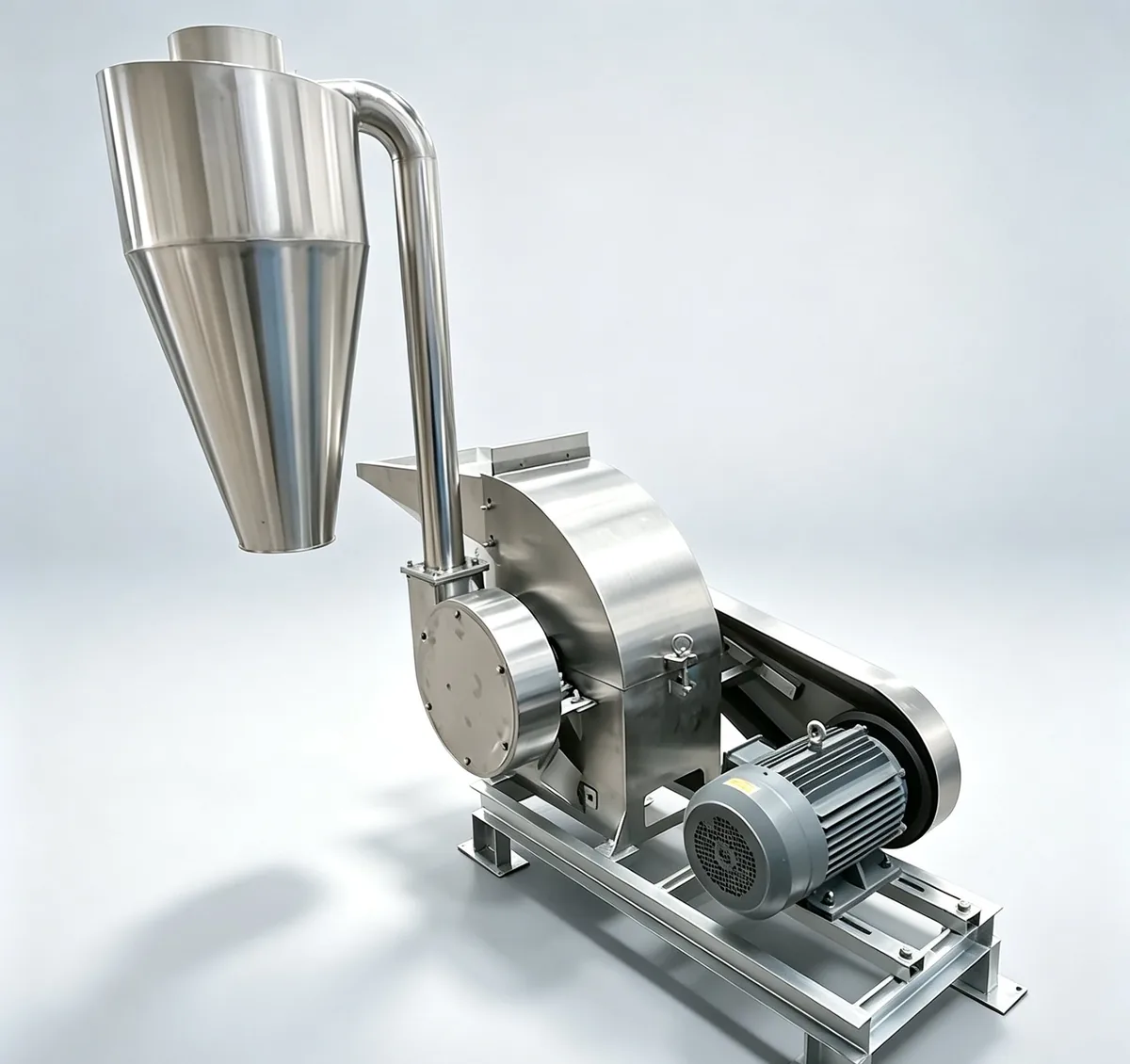
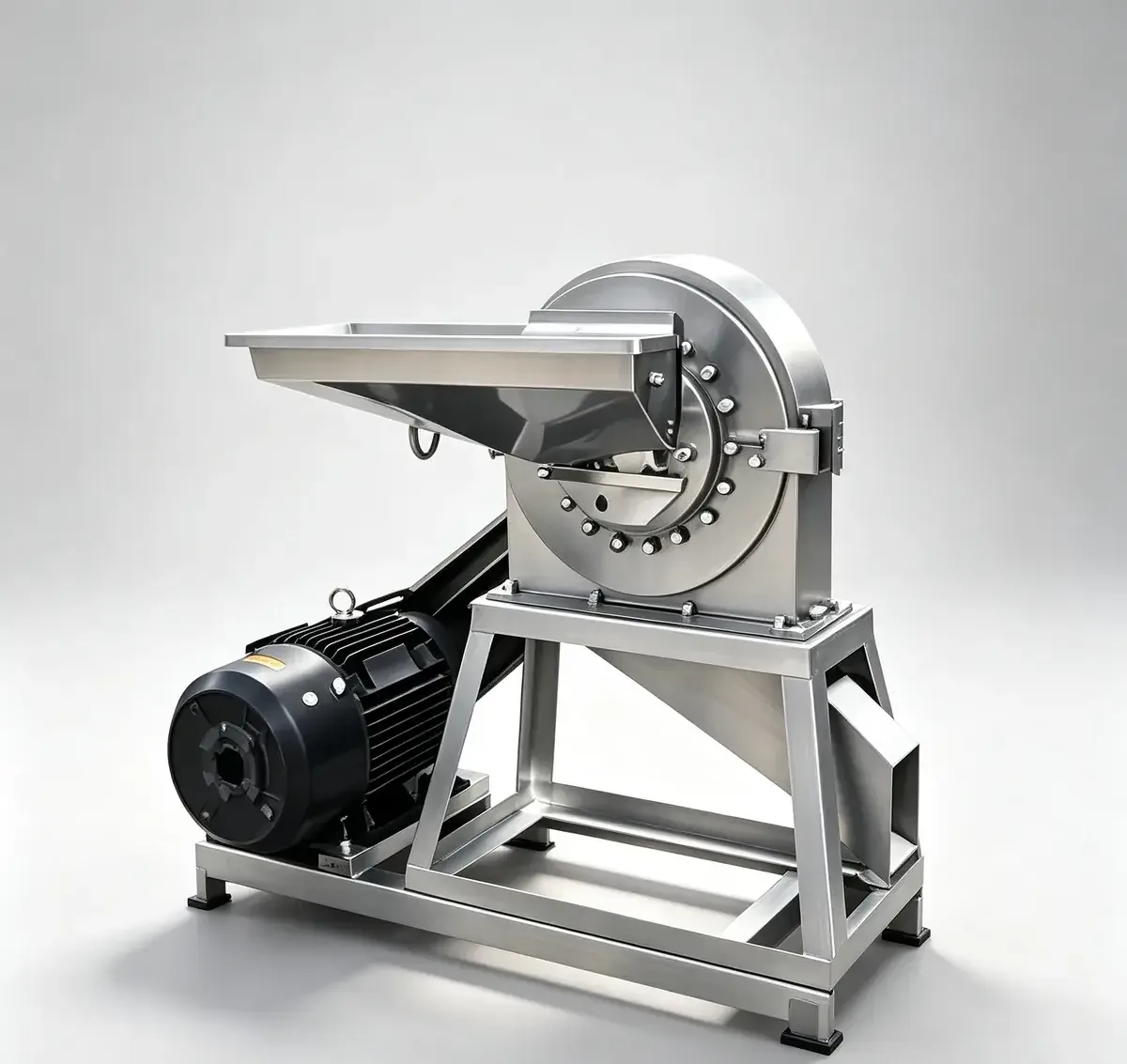
An industrial hammer mill is one of the most widely used machines for size reduction in powder processing. It uses rotating hammers inside a grinding chamber to break material through impact.
A simplified working principle is:
Raw Material ↓
Feed Inlet ↓
Rotating Rotor + Hammers ↓
Impact Grinding ↓
Screen Classification ↓
Fine Material ↓
Discharge
The screen helps control the particle size leaving the grinding chamber.
Why are hammer mills widely used? Hammer mills can be suitable for many dry materials, including:
The actual performance depends heavily on material characteristics and machine configuration. For more information, see the industrial hammer mill product page.
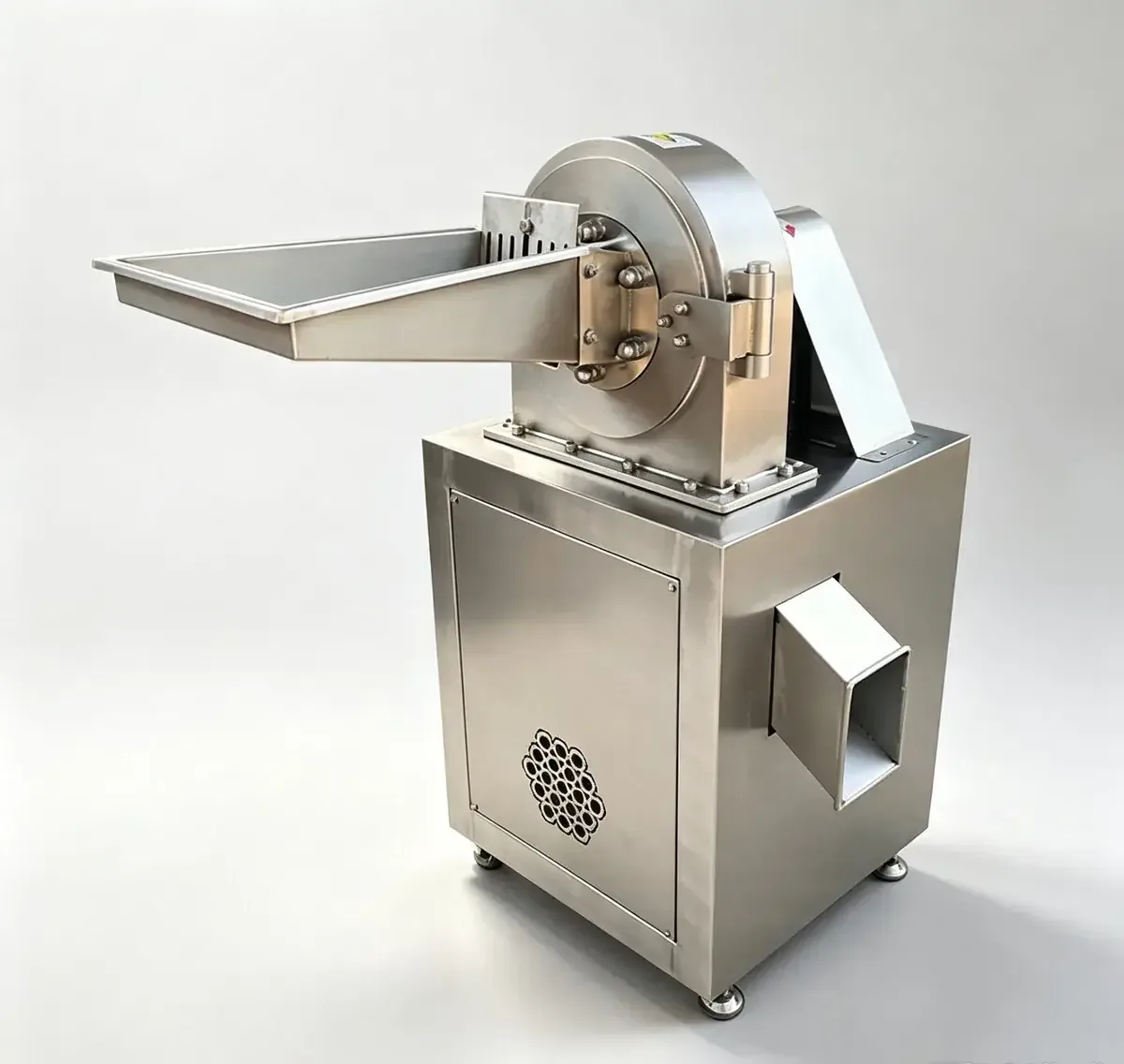
A pin mill is another type of industrial grinding machine commonly used when finer particle sizes are required. Instead of hammers, the grinding chamber contains rows of pins or similar impact surfaces.
The general process is:
Material ↓
Controlled Feeding ↓
High-Speed Pin Rotor ↓
Impact + Shearing ↓
Fine Grinding ↓
Discharge
Pin mills can be particularly useful when the application requires finer and more uniform powder. However, a pin mill is not automatically better than a hammer mill. The correct choice depends on:
See the industrial pin mill product page for detailed specifications.
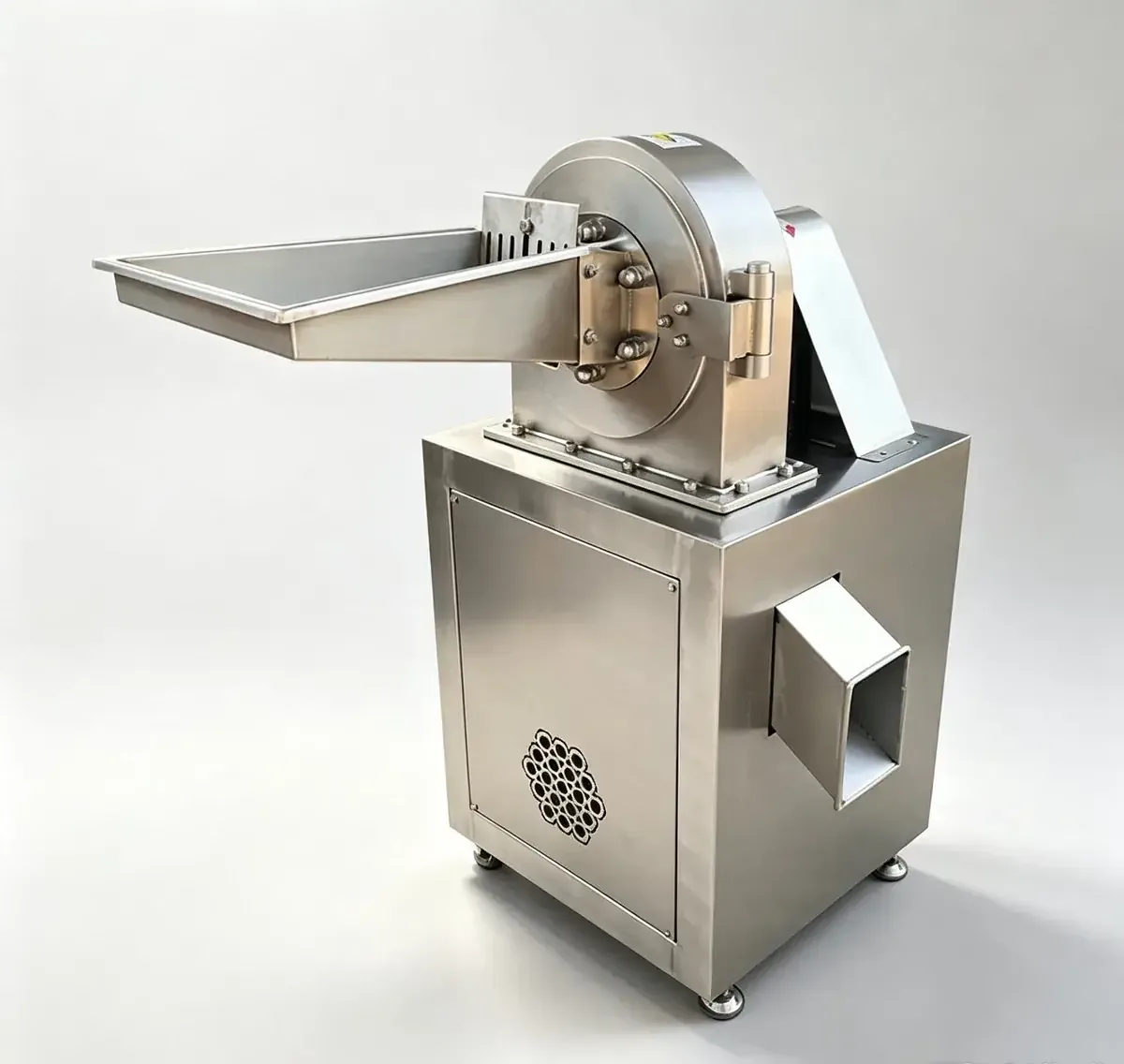
One of the most common questions when selecting grinding equipment is: should I use a hammer mill or another type of industrial grinder?
There is no universal answer. The comparison should be based on the production objective.
| Factor | Hammer Mill | Pin Mill |
|---|---|---|
| Grinding mechanism | Impact | Impact + shearing |
| Typical application | Coarse to fine grinding | Fine grinding |
| Spices | Excellent for many applications | Suitable for finer grinding |
| Grains | Common application | Application dependent |
| Fine powder | Suitable depending on configuration | Often preferred |
| Capacity | Application dependent | Application dependent |
| Material sensitivity | Depends on material | Depends on material |
| Screen-based control | Common | Design dependent |
A hammer mill may be the better choice for a high-throughput spice or grain application, while a pin mill may be more appropriate for a finer powder requirement. The best approach is to evaluate the material and target powder before selecting the machine.
Selecting an industrial grinding machine should start with five basic questions:
1. What material will be processed? Examples include chili, turmeric, ginger, pepper, herbs, corn, wheat, feed ingredients and certain chemical materials. Different materials have different hardness, fiber content, moisture and grinding characteristics.
2. What is the feed size? Large raw materials may require a crusher or pre-processing stage before entering the grinding machine.
3. What particle size is required? Examples range from coarse powder and medium powder to fine powder and very fine powder. The required particle size directly influences machine selection and configuration.
4. What capacity is required? Capacity should be evaluated in relation to the actual material rather than relying on a generic machine number.
5. Is the material heat sensitive? Some food products, spices and herbs can be affected by excessive temperature during grinding. This makes machine configuration, airflow, feed rate and process design important.
For an expanded discussion, see How to Choose an Industrial Grinding Machine.
The performance of an industrial grinding machine is determined by more than motor power.
Material properties can significantly affect grinding performance. Important characteristics include:
Two materials processed by the same machine can produce very different results.
Moisture is one of the most important factors in dry grinding. Material with excessive moisture can:
For this reason, moisture should be evaluated before selecting grinding equipment.
Large pieces may require pre-crushing. A common industrial process is:
Large Raw Material ↓
Primary Crusher ↓
Reduced Feed Size ↓
Hammer Mill ↓
Fine Powder
See the PURSYS primary crusher for pre-crushing equipment.
Particle size is one of the most important machine-selection criteria. A customer requiring a relatively coarse powder may not need the same grinding system as a customer requiring a fine powder. The final specification should therefore be defined before selecting the grinding machine.
Capacity is affected by material properties, feed size, moisture, desired particle size, screen configuration, machine size, feeding rate and grinding conditions. Therefore, a stated machine capacity should be treated as an application-dependent value rather than a universal output. For an actual project, PURSYS can evaluate the material and required output before recommending a system configuration.
Industrial grinding equipment is used across many industries.
Typical applications include chili powder, pepper powder, turmeric powder, ginger powder, grain powders and other food ingredients.
Grinding machines can be integrated into spice processing systems containing cleaning, drying, crushing, grinding, screening, dust collection and packaging. See the PURSYS spice powder processing solution.
Herbs may require controlled grinding because of their fibrous structure, moisture characteristics and sensitivity to heat. See the PURSYS herbal powder processing solution.
Grinding equipment can also be used for selected grain-processing applications. Examples include corn, wheat, rice and other dry grains. See the PURSYS grain powder processing solution.
Industrial grinding equipment can also be used for selected chemical materials when the material characteristics are compatible with the machine and process conditions. See the PURSYS chemical powder processing solution. Material compatibility should always be evaluated before equipment selection.
The hammer mill is particularly useful when the production process requires efficient impact grinding. Common applications include:
Hammer mills can be used to process chili, pepper, turmeric, ginger and other dried spices.
Depending on the material and target particle size, hammer mills can be incorporated into grain-processing systems.
Dried herbs and botanical materials may also be processed using hammer-mill technology when the material is suitable.
Hammer mills are widely associated with size reduction of feed-related materials. The exact configuration should be selected according to the material and desired final size.
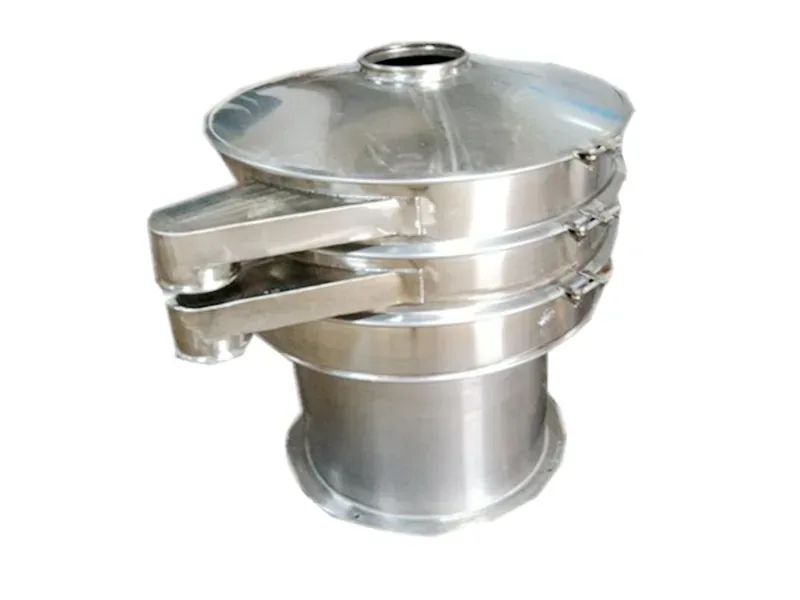
The screen is an important component of many hammer-mill systems. A simplified process is:
Material ↓
Hammer Impact ↓
Particle Becomes Smaller ↓
Passes Through Screen ↓
Finished Product
Larger particles remain in the grinding chamber until they reach a size that can pass through the selected screen openings.
Why does screen selection matter? A smaller screen opening can contribute to finer product classification, but it can also affect throughput, energy consumption, grinding efficiency, material temperature and product flow. Therefore, screen selection should balance the desired particle size with the required production capacity.
Not every powder processing line requires multiple grinding stages.
Single-stage grinding — A simple configuration may look like:
Raw Material ↓
Grinding ↓
Screening ↓
Finished Powder
This can be suitable when the raw material is already relatively small and the target particle size is achievable in one stage.
Multi-stage grinding — For more demanding applications:
Raw Material ↓
Primary Crushing ↓
Hammer Mill ↓
Fine Grinding ↓
Screening ↓
Finished Powder
Multi-stage grinding can provide better control when the raw material is large or the required final powder is significantly finer. The objective should not be to add machines unnecessarily, but to create the simplest process capable of achieving the required product specification.
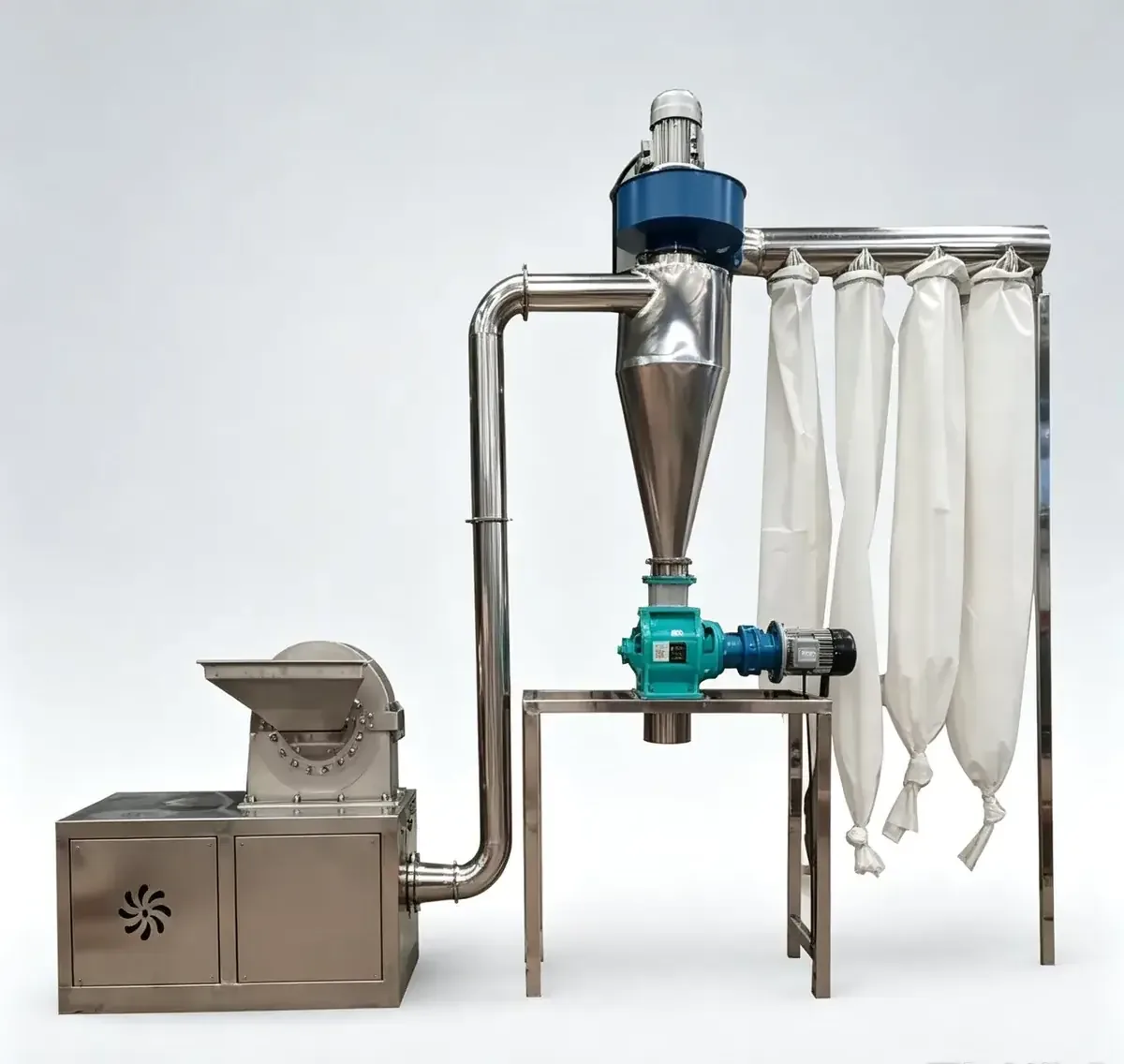
Dust management is an important part of industrial powder processing. Grinding can generate fine airborne particles, especially when processing dry spices, herbs, grains and powders.
A typical system can include:
Grinding Machine ↓
Air + Fine Dust ↓
Dust Collection System ↓
Filtered Air
Dust collection can help improve working conditions, reduce airborne dust, keep equipment areas cleaner, recover certain process materials where appropriate and support a more controlled production environment. For a complete grinding line, dust collection should be considered during system design rather than added as an afterthought.
For food and pharmaceutical-related powder processing, material selection is an important consideration. Stainless steel construction can offer advantages including:
For food applications, the required stainless-steel grade and construction should be selected according to the customer's process, cleaning requirements and applicable standards. PURSYS commonly designs powder-processing equipment using stainless-steel construction for applications where hygienic processing is required.
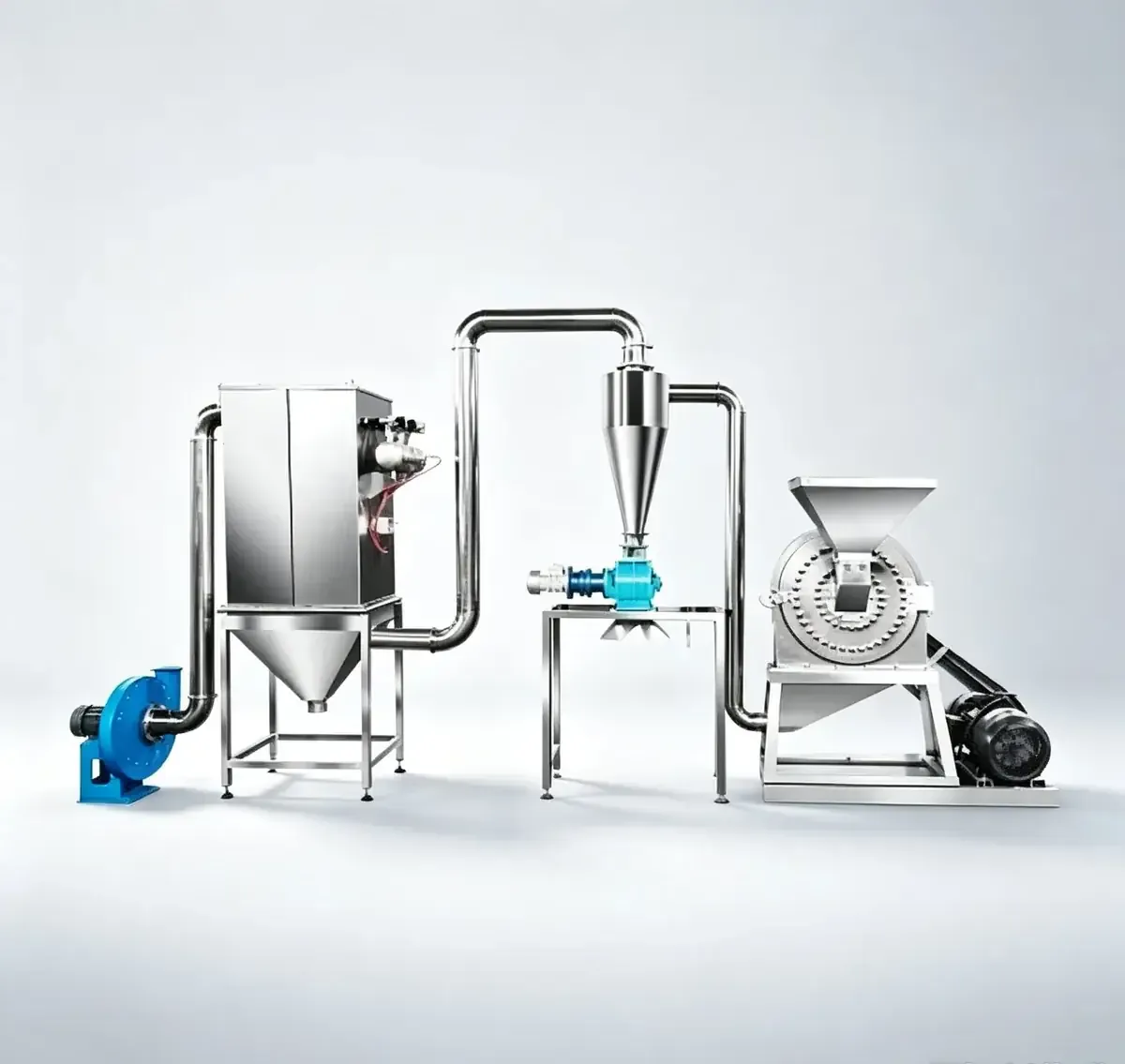
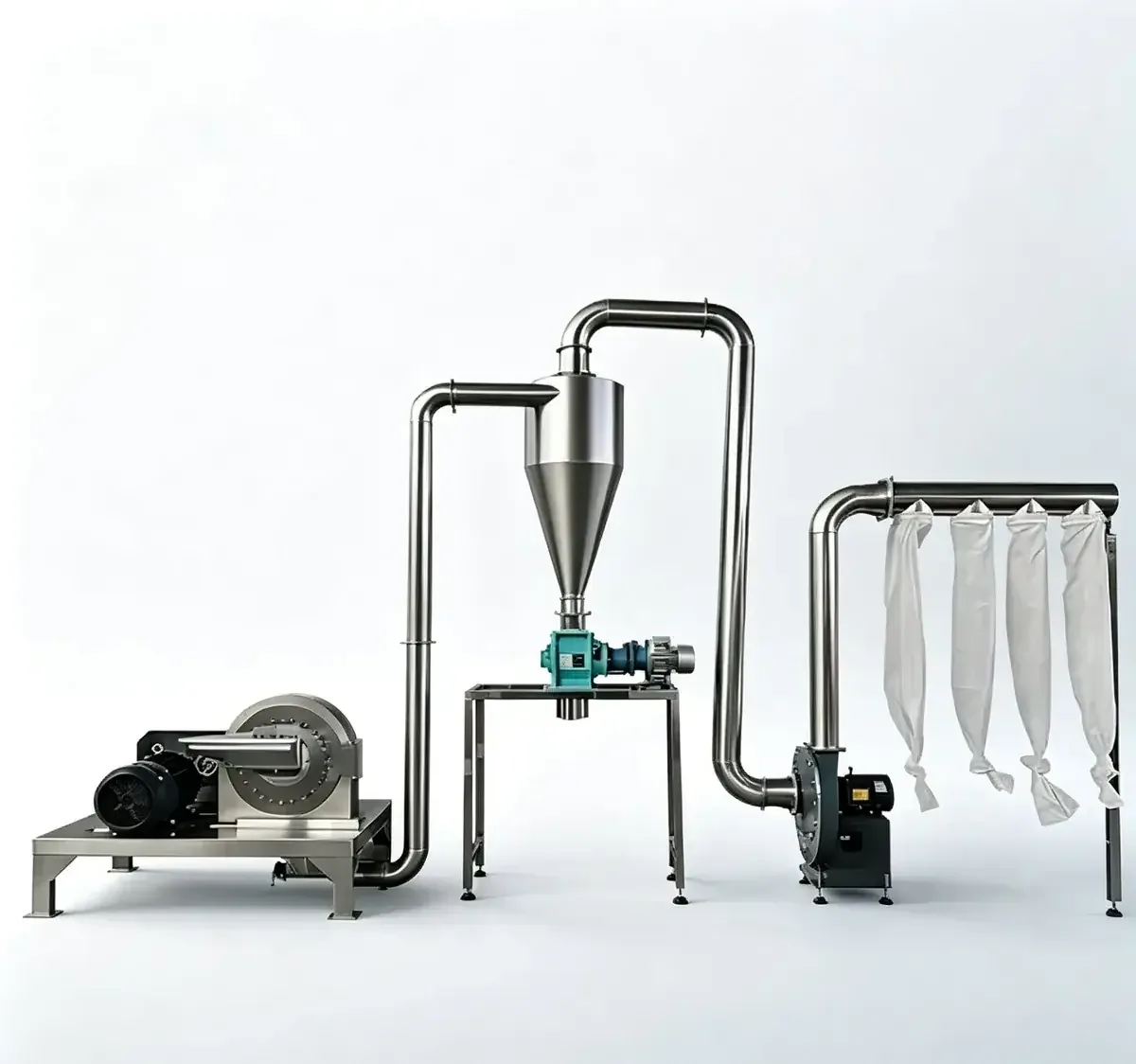
A grinding machine should not always be considered as an independent piece of equipment. In an industrial factory, the grinding machine normally works as part of a complete process.
A typical system may include:
Raw Material ↓
Feeding System ↓
Primary Crusher ↓
Industrial Hammer Mill ↓
Fine Grinding / Pin Mill ↓
Vibrating Screen ↓
Dust Collector ↓
Conveyor ↓
Packaging System
Not every project requires all of these machines. The equipment should be selected according to the actual process.
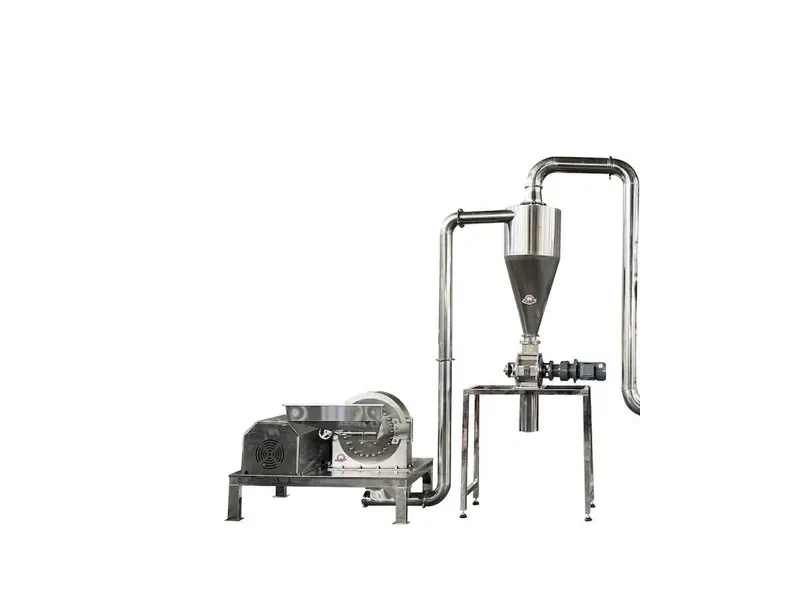
For example, a simple system may use Feeder → Hammer Mill → Screen → Packaging, while a more advanced system may use Feeder → Crusher → Hammer Mill → Pin Mill → Vibrating Screen → Dust Collector → Packaging. The second configuration may provide additional processing capability, but it also increases equipment count, investment and process complexity.
Capacity is one of the first specifications customers usually ask about. However, capacity cannot be determined from machine size alone. A grinding machine processing dry chili, turmeric, corn and a dense chemical material may have different actual outputs even when using similar equipment.
| Factor | Effect on Capacity |
|---|---|
| Material hardness | Can affect grinding efficiency |
| Moisture | Can affect flow and grinding |
| Feed size | Larger particles may require pre-crushing |
| Final particle size | Finer products generally require more grinding |
| Screen opening | Affects classification and throughput |
| Feeding rate | Controls material entering the chamber |
| Machine configuration | Affects grinding performance |
For a reliable capacity estimate, the supplier should evaluate the actual application rather than relying only on a catalog value.
The cost of an industrial grinding machine depends on the complete configuration. Important factors include:
Machine size — Larger machines generally require more material, larger components and higher manufacturing costs.
Motor and drive system — Motor selection depends on the material and required processing performance.
Stainless steel construction — Food-processing equipment with stainless-steel construction can have different costs from standard industrial construction.
Grinding configuration — A basic hammer mill and a complete fine-grinding system are very different investments.
Auxiliary equipment — A complete system may include a feeder, crusher, grinder, pin mill, vibrating screen, dust collector, conveyor, packaging machine and electrical control system.
Automation — Automatic feeding, conveying, screening and packaging can increase the initial investment while reducing manual intervention.
Therefore, when comparing industrial grinding machine prices, compare complete process configurations rather than comparing only the price of the main grinder.
Mistake 1: Choosing a machine only by motor power. A larger motor does not automatically mean better grinding performance. Material properties and final particle size are equally important.
Mistake 2: Ignoring moisture. Moisture can significantly affect grinding efficiency and powder flow. Always evaluate the raw material condition before selecting the grinder.
Mistake 3: Focusing only on capacity. A machine may have sufficient nominal capacity but fail to achieve the required particle size. Capacity and particle size must be evaluated together.
Mistake 4: Selecting the finest grinder unnecessarily. Not every application requires ultra-fine grinding. Using excessive grinding stages can increase energy consumption, equipment cost, maintenance and process complexity. The correct solution is the simplest system that achieves the required product quality.
Mistake 5: Ignoring dust collection. Powder processing generates dust. Dust collection should be incorporated into the overall system design when the application requires it.
Mistake 6: Treating every material the same. A grinding machine designed for one material does not automatically provide the same performance for another. Material testing and process evaluation are important for demanding applications.
PURSYS approaches grinding equipment as part of a complete powder-processing solution rather than treating the grinder as an isolated machine. Depending on the project, a system can include feeding equipment, primary crusher, hammer mill, pin mill, vibrating screen, dust collector, conveying equipment, mixing equipment, packaging equipment and electrical control system.
The basic engineering process is:
Customer Requirements ↓
Raw Material Evaluation ↓
Target Particle Size ↓
Required Capacity ↓
Grinding Method Selection ↓
Auxiliary Equipment Selection ↓
Complete Process Design ↓
Equipment Manufacturing ↓
Installation / Commissioning Support
This approach helps ensure that the grinding machine works correctly with the upstream and downstream equipment.
If you are requesting an industrial grinding machine quotation, providing detailed application information can help the manufacturer recommend the correct configuration. We recommend providing:
Raw material — What material will you grind? Example: dried chili.
Initial particle size — How large is the raw material before grinding?
Moisture content — Approximately how much moisture does the material contain?
Target particle size — For example: fine powder, or provide the desired mesh/particle-size specification if known.
Required capacity — For example: ___ kg/h.
Working hours — For example: 8 hours/day.
Material-contact requirements — For food applications, specify whether stainless-steel construction is required.
Complete line requirements — Tell the supplier whether you need a grinding machine only, grinding + screening, a complete grinding line, a complete powder processing line or a grinding + packaging system.
The more information provided, the more accurately the system can be designed.
Consider a hypothetical dried spice powder application. The process could be:
Dried Spice ↓
Cleaning ↓
Primary Crushing ↓
Hammer Mill ↓
Fine Grinding ↓
Vibrating Screen ↓
Dust Collection ↓
Finished Powder ↓
Packaging
The actual equipment configuration would depend on spice type, moisture, feed size, required particle size, production capacity, temperature requirements and packaging specification. This is why a complete process evaluation is more useful than selecting a grinder from capacity alone.
The best industrial grinding machine is not necessarily the largest or most powerful machine. The correct solution should balance Material + Feed Size + Moisture + Particle Size + Capacity + Process Configuration.
A practical selection process is:
1. Identify Material ↓
2. Evaluate Feed Size & Moisture ↓
3. Define Target Particle Size ↓
4. Define Required Capacity ↓
5. Select Grinding Technology ↓
6. Determine Screening & Dust Collection ↓
7. Design Complete Processing System
For many general powder-processing applications, a hammer mill can provide an efficient starting point. For finer grinding requirements, a pin mill or additional grinding stage may be appropriate. The important point is to design the process around the required powder, rather than selecting equipment based on one specification alone.
PURSYS focuses on industrial powder processing and equipment integration. Our equipment portfolio includes industrial hammer mills, pin mills, primary crushers, vibrating screens, conveyors, mixing equipment, dust collection systems and packaging systems. For customers requiring more than a single machine, PURSYS can combine individual machines into a complete powder-processing system according to the material and production requirements.
Looking for an industrial grinding machine, hammer mill or complete powder processing system? Send PURSYS the following information and our engineering team can evaluate the process and recommend a suitable grinding configuration.
PURSYS — Industrial Powder Processing Equipment & Complete Grinding Solutions.
A turmeric powder production line is more than a turmeric grinding machine. A properly designed system considers the entire process:
Feeding → Cleaning → Moisture Control → Crushing → Grinding → Fine Grinding → Screening → Dust Collection → Conveying → Packaging
The correct configuration depends on the raw material, moisture content, production target and final powder specification. For industrial projects, the goal should not simply be to find the most powerful grinder. The better approach is to design a balanced processing system in which each stage supports the next.
If you are planning a turmeric powder processing project, PURSYS can help evaluate the material, processing requirements and production target to develop a suitable equipment configuration.
Need a turmeric powder production line? Tell PURSYS your raw material + required capacity + target powder fineness. Explore our turmeric powder processing guide, industrial hammer mill, pin mill, vibrating screen and full range of PURSYS powder processing equipment, or get a quote.
Copyright © Zhengzhou Pursys Machinery Co., Ltd. All Rights Reserved. | XML Sitemap | Site Map
Zhengzhou Pursys Machinery Co., Ltd.
+86 177 2975 3706
+8617729753706
No.21 South Huagong Road, Zhangcun, Gaocun Township, Xingyang City, Zhengzhou City, Henan Province, P.R.China