Mobile:
+86 177 2975 3706
E-mail:
info@pursysmachine.com
News · Aug. 14, 2026 · Spice Processing
Spices are used in food manufacturing, seasoning production, ingredient processing and many other industries. Producing consistent spice powder at industrial scale requires more than simply reducing the size of raw spices. The grinding system must be selected according to the characteristics of the material, required particle size, production capacity, temperature requirements and final product quality. An industrial pulverizer machine is designed to reduce whole or pre-processed spices into a controlled powder suitable for further processing, mixing or packaging. Depending on the application, a spice processing system may include a grinder, feeding system, dust collector, cyclone separator, vibrating screen and packaging equipment. This guide explains how industrial spice grinding works, which machines can be used, how to select the right equipment and what to consider when designing a complete spice powder production line.
An industrial spice grinding machine is equipment designed to reduce spices into smaller particles or powder for commercial production. Unlike small household spice grinders, industrial equipment is designed for:
Common materials processed by industrial spice grinding systems include chili, black pepper, white pepper, turmeric, ginger, cinnamon, cumin, coriander, cardamom, dried herbs and other dried spices. The appropriate grinding machine depends on the physical characteristics of the spice and the required finished powder.
A typical spice grinding process can be organized into several stages:
Not every production line requires every stage. For example, a small processing system may use only a grinder and dust collector, while a larger factory may require a complete automated processing line.
Grinding performance starts with the condition of the raw material. Before grinding, spices may need to be cleaned, dried, sorted, de-stoned, pre-crushed and stored under controlled conditions. Moisture is particularly important. If a spice contains excessive moisture, it may reduce grinding efficiency, cause material to stick inside the grinding chamber, increase screen blockage, affect powder flow and change the final particle-size distribution. For this reason, moisture content should be considered before selecting the grinding equipment.
Consistent feeding is important for stable grinding performance. An uncontrolled feed rate can cause fluctuations in capacity, motor load, particle size and product temperature. Industrial spice processing lines may use different feeding systems depending on the production requirements, for example hopper feeding, screw feeding, vibratory feeding or automatic metering systems. The feeding system should be matched to both the material and the grinding machine.
The grinding machine performs the main size-reduction process. For spice processing, different grinding technologies can be considered.
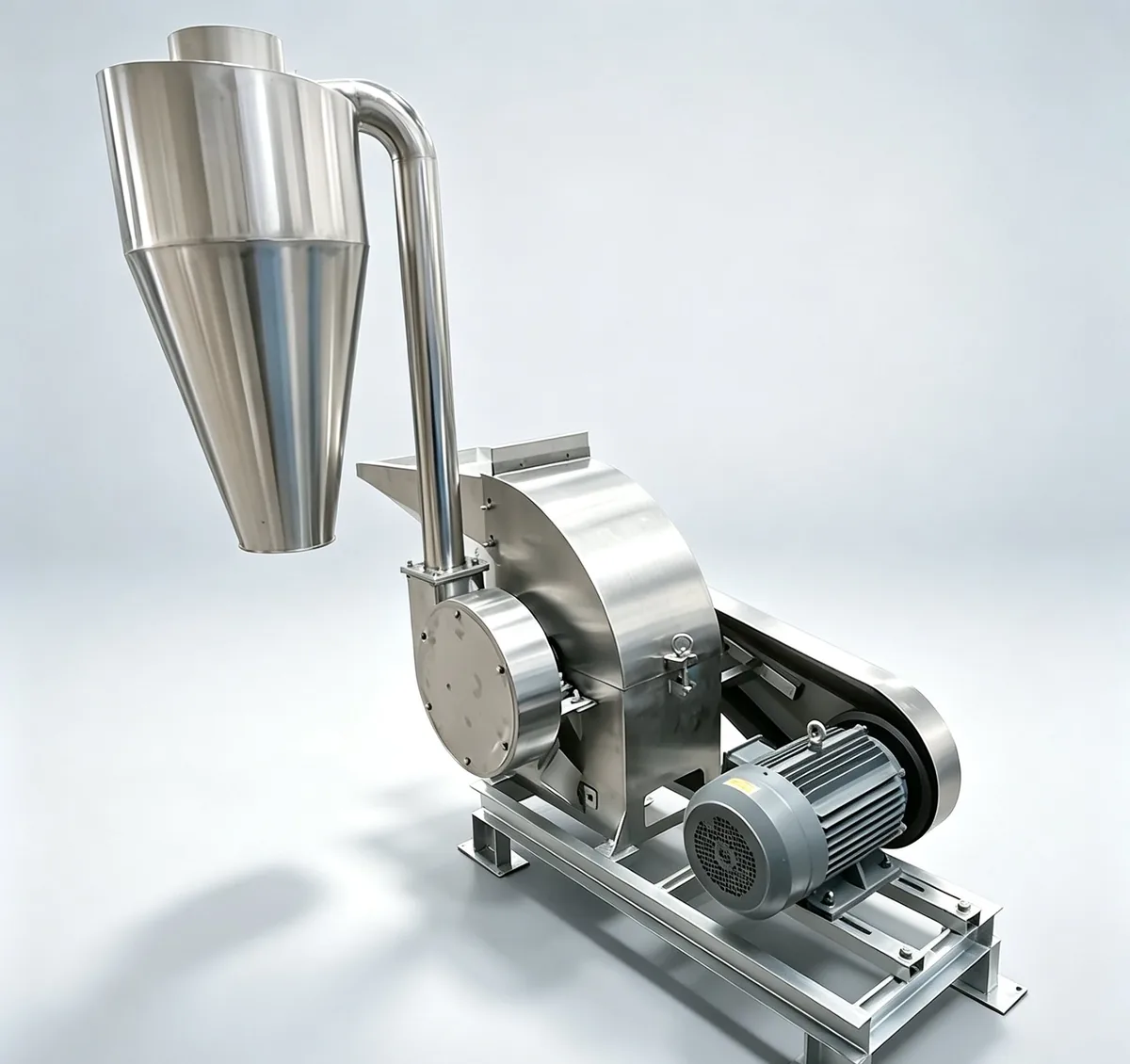
Hammer mills use high-speed rotating hammers to generate impact forces. They are commonly considered for chili, pepper, turmeric, ginger, dried herbs and other agricultural materials. A hammer mill can be a practical choice when the process requires robust size reduction and relatively high throughput. Learn more: Hammer Mill Working Principle.
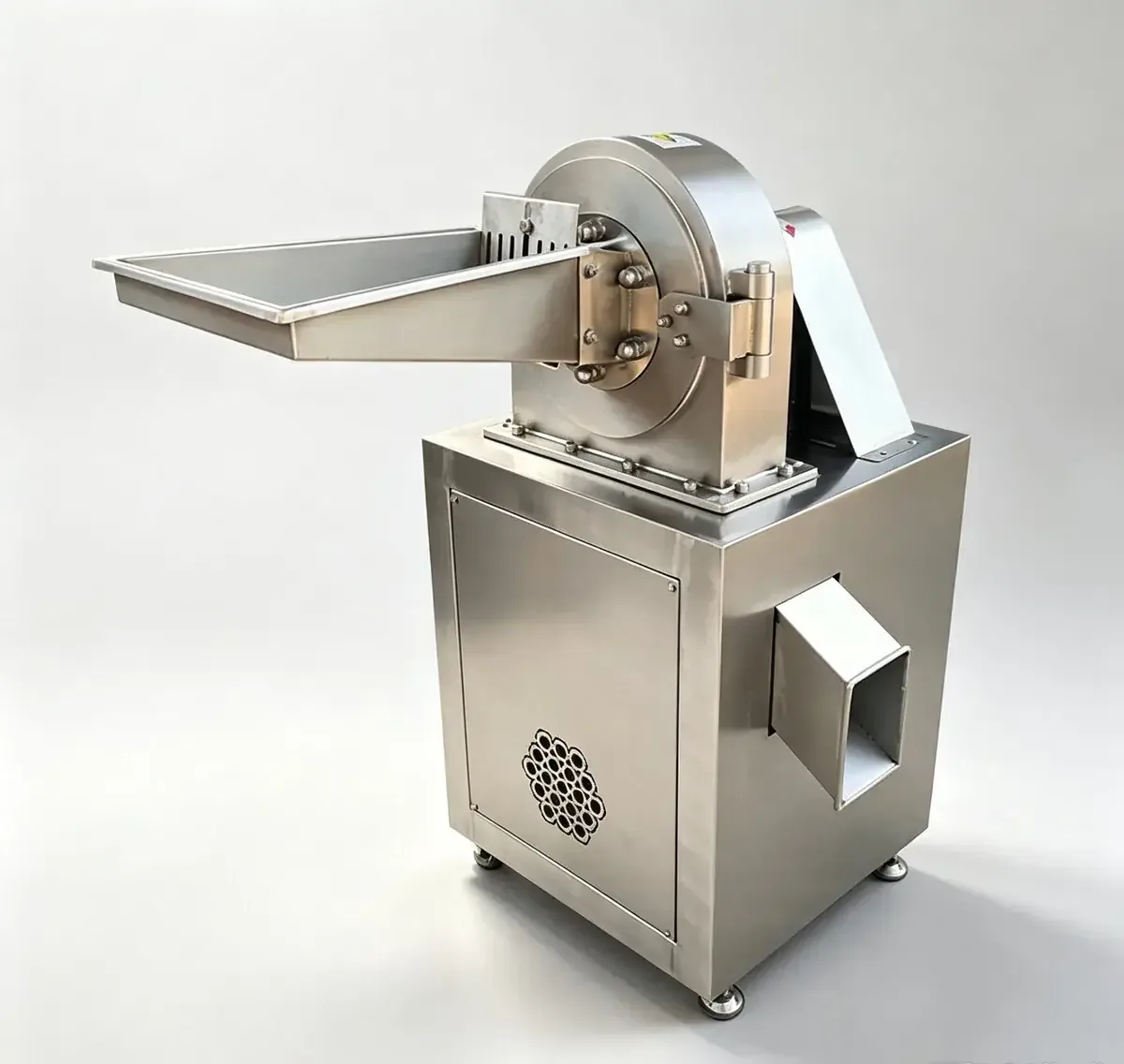
Pin mills use high-speed rotating pins to generate impact and shear forces. They can be considered when fine powder is required, the material is suitable for high-speed grinding and particle-size reduction is the main objective. For a detailed comparison: Hammer Mill vs Pin Mill.
There is no single particle size that applies to every spice grinding machine. The achievable powder fineness depends on spice characteristics, moisture content, machine type, rotor speed, screen size, feed rate, grinding configuration and cooling conditions. Instead of selecting equipment based only on a machine's maximum capacity, define the required final particle size first. Typical specifications may be expressed using mesh, microns or particle-size distribution, for example coarse powder, medium powder, fine powder or very fine powder. The actual target should be confirmed through testing with the specific spice.
Different spices have different physical properties. Harder materials may require stronger impact forces or different grinding configurations.
Moisture can significantly influence grinding behavior. Too much moisture may increase sticking, screen blockage, power consumption and cleaning requirements. Proper raw-material preparation can therefore improve grinding stability.
Some spices contain relatively high levels of natural oils, including certain varieties of pepper, cumin, coriander and other aromatic spices. Higher oil content can affect powder flow and grinding behavior. The machine configuration should therefore be selected based on actual material characteristics.
The finer the required powder, the more demanding the grinding process can become. Fine grinding may require different grinding equipment, multiple grinding stages, different screen configurations, controlled feeding and cooling or airflow management.
Capacity is another important consideration. A buyer should not select a grinder simply because the machine has a high advertised capacity. Actual production capacity depends on material, moisture, feed size, target fineness, machine configuration, feeding rate and operating conditions. For example, a machine may process a relatively coarse product at a higher rate but achieve a lower capacity when producing very fine powder. When requesting a quotation, provide both required capacity and required particle size, for example "300 kg/h of turmeric powder at the required final particle size." This gives the equipment supplier much more useful information than simply saying "I need a 300 kg/h grinder."
Before purchasing equipment, consider the following factors. For a broader framework, see our guide on how to choose an industrial powder grinding machine.
Start with the exact material, for example chili, turmeric, pepper, ginger, cinnamon or cumin. Different materials can behave differently during grinding.
Specify your target production rate, for example kg/h, tons/day or tons/month. Also consider whether production is batch, semi-continuous or continuous.
This is one of the most important specifications. Specify mesh, microns or particle-size distribution. If possible, provide a sample of the desired finished powder.
Grinding can generate heat. This can be particularly important for spices because aroma, color and other product characteristics may be affected by processing conditions. The acceptable temperature range should therefore be discussed before equipment selection.
For food and spice processing, stainless steel construction is commonly considered because of corrosion resistance, hygienic surfaces, easier cleaning and food-processing suitability. The appropriate stainless steel grade should be selected according to the application and applicable requirements.
Spice grinding generates airborne fine particles. Without appropriate dust management, the processing area can experience dust accumulation, product loss, difficult cleaning, poor working conditions and cross-contamination concerns. A spice grinding system may therefore integrate a cyclone separator, dust collector, filter system and negative-pressure conveying. The exact configuration depends on the material and production process. Dust collection should be considered as part of the complete grinding system rather than as an afterthought.
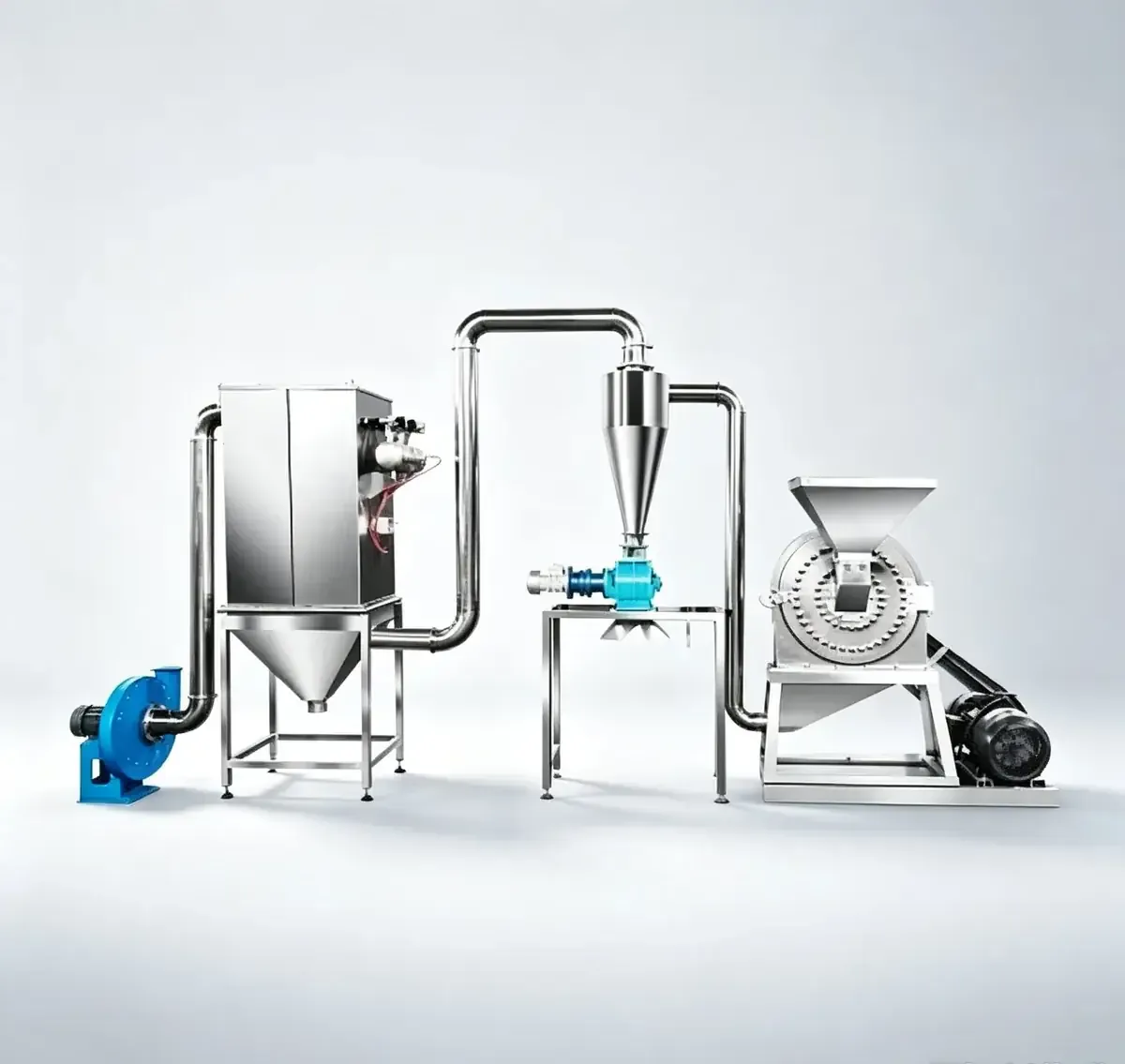
For larger factories, a grinder alone may not be enough. A complete spice powder processing system can include raw material feeding, cleaning, drying, pre-crushing, hammer mill or pin mill, cyclone and dust collection, vibrating screen, powder storage and packing machine. The actual configuration should be customized according to the material and production requirements. For example, a production line for dried chili may be different from a line designed for turmeric or herbal materials.
| Factor | Small Grinder | Industrial Grinding System |
|---|---|---|
| Production capacity | Lower | Higher |
| Feeding | Manual | Automatic or continuous |
| Dust control | Limited | Integrated system |
| Particle-size control | Basic | More controlled |
| Cleaning | Manual | Designed for easier access |
| Automation | Limited | Optional |
| Production line integration | Limited | Customization |
For factories producing spice powders commercially, an integrated industrial system can provide better consistency and production efficiency.
Both machines can be used for spice processing, but the appropriate choice depends on the application. A hammer mill may be suitable when high throughput is important, the material requires robust size reduction, the spice is relatively coarse and a screen-based grinding system fits the process. A pin mill may be suitable when fine grinding is required, the material responds well to high-speed impact and shear and a different particle-size reduction mechanism is preferred. For difficult applications, a material test is the best way to determine the appropriate machine. Read: Hammer Mill vs Pin Mill: Which Grinding Machine Is Better?
A machine advertised as 500 kg/h does not necessarily produce 500 kg/h at your required fineness. Capacity should always be evaluated together with particle size and material.
Moisture can have a significant impact on grinding performance. Always provide the approximate moisture content of the raw material.
For aromatic and heat-sensitive spices, temperature should be considered during equipment selection.
A grinder may perform well mechanically but still create problems if dust is not properly managed.
Two materials that look similar can behave very differently during grinding. A sample test can provide much more reliable information than a general machine specification.
| Requirement | Example |
|---|---|
| Material | Chili / turmeric / pepper |
| Raw material condition | Dried |
| Moisture | Approx. 8% |
| Feed size | 5-20 mm |
| Capacity | 300 kg/h |
| Final particle size | 60-100 mesh |
| Operation | Continuous |
| Construction | SUS304 |
| Packaging | Automatic |
| Dust control | Required |
Providing this information can significantly improve the accuracy of equipment recommendations.
PURSYS focuses on industrial powder processing equipment and customized grinding solutions. For spice processing applications, the system can be configured around industrial hammer mills, pin mills, feeding systems, vibrating screens, dust collection systems, powder conveying and packing equipment. The goal is not simply to supply a grinding machine, but to develop a powder processing system that matches the customer's material, capacity and final product requirements. For a customized recommendation, provide your material information, target capacity and required powder fineness.
Selecting an industrial spice grinding machine requires more than comparing machine prices or motor power. The right equipment should match raw material characteristics, moisture content, production capacity, required particle size, product temperature, hygiene requirements, dust-control requirements and future production plans. Hammer mills can provide robust and versatile size reduction for many spice-processing applications, while pin mills can be considered for applications requiring finer grinding. For larger production facilities, the grinder should also be evaluated as part of a complete system that may include feeding, screening, dust collection, conveying and packaging. If you are planning a new spice powder production line, providing your material, capacity and target particle size is the best starting point for selecting the right grinding solution.
For more on grinding equipment, explore our industrial hammer mill, pin mill and the full range of PURSYS grinding equipment.
Copyright © Zhengzhou Pursys Machinery Co., Ltd. All Rights Reserved. | XML Sitemap | Site Map
Zhengzhou Pursys Machinery Co., Ltd.
+86 177 2975 3706
+8617729753706
No.21 South Huagong Road, Zhangcun, Gaocun Township, Xingyang City, Zhengzhou City, Henan Province, P.R.China